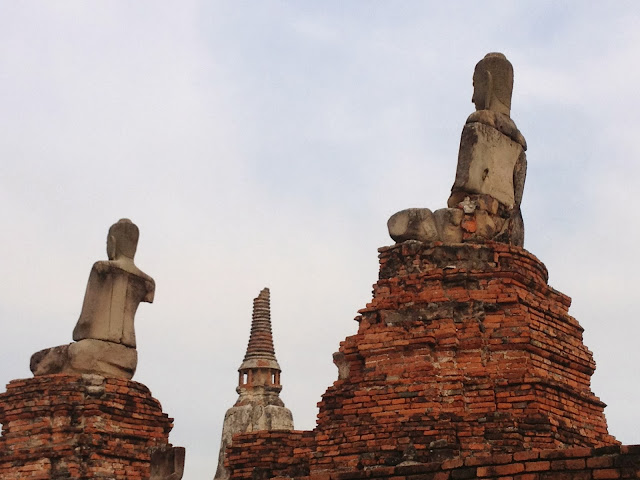
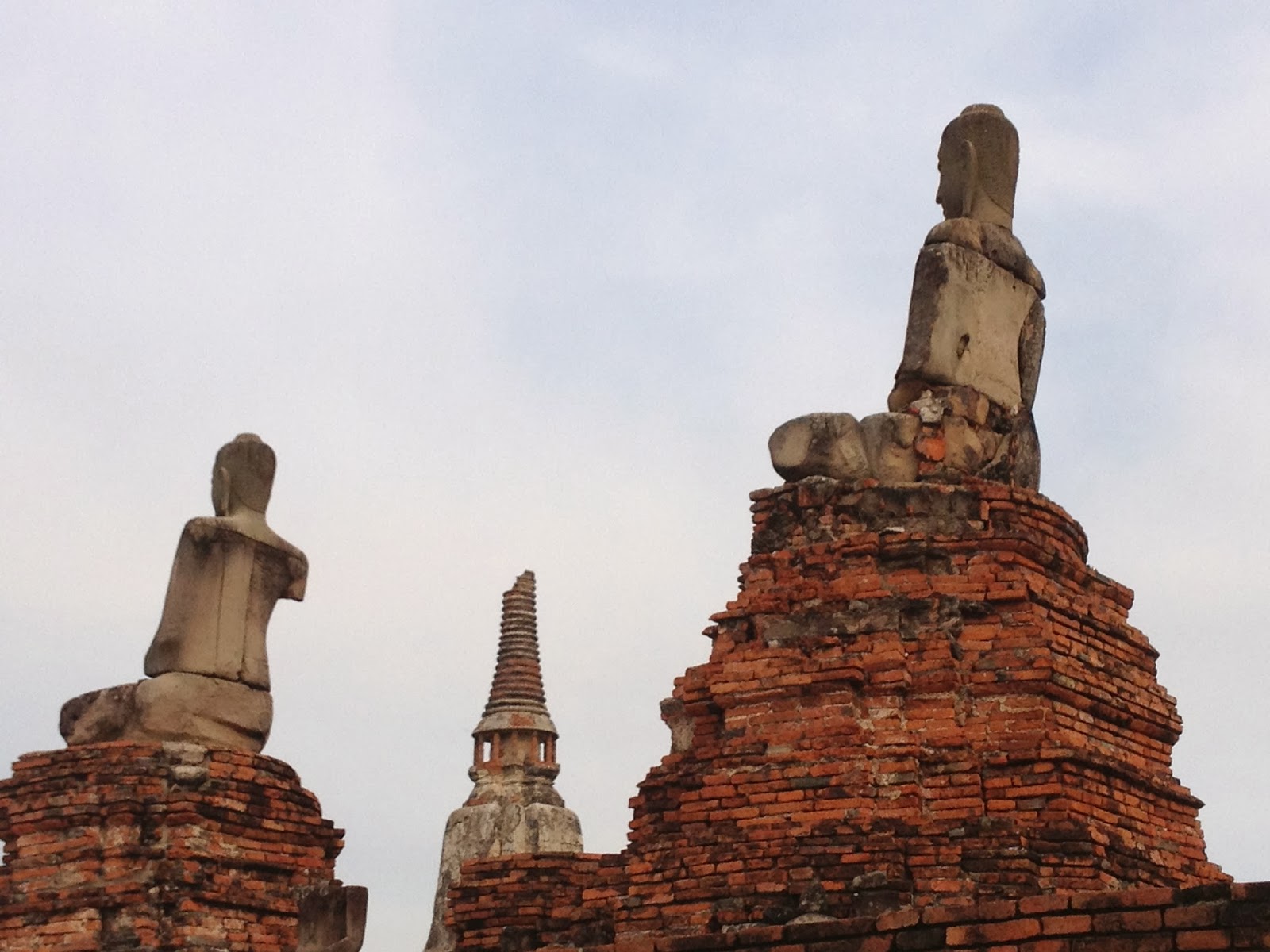
Ayutthaya is located about 70k north of Bangkok on the Chao Phraya river. The same river that flows through Bangkok. Ayutthaya was the capital of Thailand after the capital of Sukothai was absorbed by Ayutthaya in 1350 until the Burmese destroyed the city in 1767. Thirty-three Kings ruled over Ayutthaya during that time, and it was the largest city in the world, a center of trade with over a million people, described by visiting Europeans as the most magnificent city in the world. All that ended when the Burmese burned and looted the city. All that remains now are the ruins, the river, and the modern city that was built around these ruins. Many of the items in the National Museum in Bangkok come from the Dhvarti period- before Thailand, the Sukothai period, the Ayutthaya period, and the Bangkok period.
The following is an ancient bell. It looks like a rock to me. I guess a rock, can be a bell, or a bell can be something other than something you ring.
The following I got into trouble for photographing. I didn't realize there was no photography in this room of the museum. Oops. These are the relics recovered from Wat Phra Mahathat. When a Wat has the title Mahathat, there is a relic of the Buddha interred at the Wat. Archeologists recovered this relic 17m below the main stupa and the ornate package surrounding it to great fanfare in 1956. I can't remember exactly, but I think the first and largest stupa was lead, next silver, then a gold alloy, Next ebony with a gold top, and then redwood. Last was a gold and gem encrusted stupa that held a tiny speck 1/8 the size of a rice seed. Relics would often be bones, teeth, hairs of Buddha, and it is believed that they can create a clone of themselves. Very Indian Jones.

At the National Museum in Bangkok free tours in English are offered on Wednesday and Thursday mornings at 9:30. I highly recommend this. In fact it might just be the best thing you can do in Bangkok. I learned more here, from my wonderful guide on our 3 1/2 hour tour, then from any other place or book. I will share some of this knowledge in this blog. For example, the meaning of the color red in Thai culture. Here in the mural below, you see a red lighting bolt shape surrounding Buddha. The red is supposed to 1) invisible and 2) it draws attention to an important thing. Often the ceiling of a temple is painted red to signify that even within the walls of the temple, we are still connected to the universe.

The following shot barely captures the splendor of the royal pyres used for funerals of royals. Again, you see the Naga. A LOT OF THEM! With crystal eyes and colored mirrors and gilded scales. And this is real gold leaf. They were restored last year with gold leaf and q-tips. They are pulled by men dressed in red. That is because the red makes them invisible, and it looks as if the royal pyre is floating in the air pulled by the naga. If you have a strong stomach check out the customs dealing with royal deaths in Thailand.

Thailand is a land of elephants. Below is some carved ivory tusks. Notice again the point of the ivory is a naga head. The other photo was taken from the Royal White Elephant Museum at the Dusit Palace. Touring the Dusit Palace compound took up an entire afternoon. There was so much to see. There is the largest teak mansion in the world, where kings and queens lived not too long ago. There is many textile museums where you can learn more about Thai weaving and patterns from different Thai regions and ethnicities. Also, there is the elephant coral. Any white elephant born in Thailand is very auspicious and belongs to the king. This was where the elephants used to live. Today, there are 10 white elephants
http://www.thailandelephant.org/en/royalstable.html Here is a video of HRH and some of the Auspicious Elephants.
http://www.youtube.com/watch?v=x1spaYhmFCw
Those of you who know me know I love beads and rocks. Beads made out of rocks are cool too. Here on display are some very old beads from the U-Thong kingdom. This was located in the area of Suphanburi. This kingdom, later moved to form the Ayutthaya kingdom. Suphan Buri was where I lived for my first 10 weeks here in Thailand. It is where my Thai "family" live. While in Suphan Buri, I purchased a strand of these ancient beads. I love them, and wear them every day. Some are colored glass and some are agate.


Speaking of elephants, this god is Ganesh. Since learning some of his stories, I feel like I see him everywhere I look. He is a god who always says "yes" if you pray hard enough. Therefore, he is in many boys pockets as they ask a girl out. He is also the patron saint of arts. Therefore, my museum ticket had a symbol of Ganesh on it. The theater has a statue of Ganesh. Many places have Ganesh displayed. Thailand began as Hindu country, and later became Buddhist. Many of the gods of Hinduism are still seen. Here is a Shiva Lingum. Brahma and Vishnu are also represented by the eight and four sided shaft.
This is Garuda, the vehicle of Vishnu. Garuda is the national symbol of Thailand, so you see him on banks, and letterheads. He is also represented on Thai temples on each roof bargeboard as a eagle like shape.


 |
| The Spirit House of Pront Palace was originally constructed by Vice Deputy King Boborn Maha Sura Sighanatduring the Bangkok period during the reign of King Rama 1 (1782-1803). It was constructed at the same time, or shortly after the construction of the Pront Palace in 1782. It was believed the land on which the Pront Palace was erected had a previous owner and therefore it was necessary to construct the Spirit House as a replacement dwelling for that owner. The house is situated on a miniature mountain imitating a natural setting inspired by Chinese art. It was subjected to significant modification during the reign of King Rama 2. Inside the spirit house is a wood sheet on which is painted a Dheva, a symbol of the spirit and God protector of the front palace. |
Today, the spirit house is considered to be one of the most sacred places of the Fine Arts Department.
|
Ayutthaya:
 |
| I never noticed the sleeping dog in the corner, until just now. Ayutthaya has hundreds, if not thousands of wild dogs. |